


Word Bird: A playful puppet program for pre-literacy and phonological awareness
Word Bird lays an egg with a word inside. Children clap syllables, spot rhymes and link first sounds to letters, building playful foundations for reading and writing before they start school.

Meet Word Bird

Words are more than their meaning
To very young children, a word is all about what it means. A dog is a furry animal that barks. Noticing that "dog" is also made of sounds, and that those sounds can be written with letters, is a big shift in thinking.
This awareness of the sound structure of words, known as phonological awareness, underpins early literacy. Word Bird gives children a playful reason to explore it: every word arrives in an egg, and every egg is worth a closer look.
Word Bird does not ask children to read or write. It lays the foundations for the formal literacy learning that starts at school, through short, joyful sessions at mat time.
Inside a Word Bird session
Word Bird "lays an egg" in her nest. There's a word inside, and the children can't wait to find out what it is.
From there, Word Bird and the group explore the word together: its sounds, its letters and what it means. Every session is a little different, and every one ends with children wanting to know what she'll lay next.
Fully scripted
Step-by-step session scripts and a one-page cheat sheet mean you can start with confidence from the very first session.
Whole group, at mat time
Sessions suit the whole kindergarten group and fit into a short mat-time slot, one to three times a week.
Families come along too
After each session, families hear about the word their child discovered, with ideas to keep it playful at home. Children are never tested on it.
Building blocks for early literacy
Across the sessions, children explore five pre-literacy skills.
The concept of a word
Long and short words, and real and not-real words. Children start to see words as things they can think and talk about.
Rhyme
Children start to hear when words rhyme, and have a go at finding rhymes of their own.
Clapping syllables
Children clap the beats in words along with Word Bird, from short words to long, tricky ones.
First sounds
Children tune in to the sound at the start of a word.
First letters and their names
Children begin to link first sounds with the letters that make them, and learn letter names.
Starting with the basic code
Letter-sound links follow the basic code children meet first in Foundation, so what they explore with Word Bird lines up with what comes next at school.
A free screening tool for Word Bird educators
Everyone who buys the program can register for the free Word Bird screening tool at wordbird.pelicantalk.com. Registration is approved before a centre starts using it.
Quick and familiar
Under five minutes per child, one-on-one with a familiar educator from the child's own centre, for children in the four-year-old kindergarten group.
Works offline
Runs on a tablet with no internet connection needed.
Pre-program screen
At the end of Term 3 or the start of Term 4, before the sessions begin.
Post-program screen
After all 12 sessions, usually in the last fortnight of Term 4.


Results are reported in three areas:
- Concepts of Literacy
- Phonological Awareness
- Letter-Sound Knowledge
Compare pre-program and post-program results side by side to:
- See how far children have come
- Plan extra practice
- Notice children who may need more support
It's not pass or fail.
It helps educators plan, and families get activities for home.
Who uses Word Bird?
Designed for early childhood settings in the year before school.
Kindergarten and preschool educators
Run short, playful sessions at mat time with the whole group. Scripts and a cheat sheet mean educators and education support assistants can start with confidence, and the wall collage keeps every word in view.
Speech pathologists
Support centres with a structured, play-based approach to phonological awareness, and use screening results to talk about which children may need more support.
Centre leaders
A ready-made Term 4 program for school readiness, with a free pre-program and post-program screen and built-in ways to keep families involved.
What's included
The Word Bird puppet and egg are posted to you, and the 57-page program is an instant download. Print it or view it on a screen.
-
Word Bird puppet (58.5 cm). Work her beak, or put your hands in her wings to flap and clap. Her bald pink bottom is a guaranteed laugh.
-
Plastic egg. One coloured, fillable egg.
-
57-page program. A downloadable program, including:
- Set-up guide (a basket for a nest, word slips cut from A4 copier paper, paper egg templates)
- Wall collage template
- Step-by-step session scripts for long and short words, plus a one-page cheat sheet
- Extension tasks
- Rhyming picture cards and start-sound pictures, with graded follow-up activities
- Ideas for communicating with families
- A "Getting ready to read and write" checklist
-
Screening materials. Including a caregiver consent form.
-
Free screening tool access. Register for the Word Bird screening tool after purchase.

Word Bird in the kindergarten room
Kids love Word Bird!


Created by a speech pathologist
Word Bird was developed by speech pathologist Lucia Smith to help children notice the sounds inside words before they start school.

Lucia Smith
Speech Pathologist
Lucia is an Australian Certified Practising Speech Pathologist with over 30 years' experience.
She has been writing and illustrating for Pelican Talk Speech Therapy Resources since 2012, drawing on evidence-based practice and her extensive clinical work with children across a wide range of settings and age groups.
Lucia is also the developer of a specialist training program focused on using puppets to support social and emotional learning. This program has been listed on the Victorian School Readiness Funding Menu since 2021.
Frequently asked questions
Common questions from educators, speech pathologists and centre leaders about Word Bird.
What age is Word Bird for?
Will children learn to read with Word Bird?
How long is each session, and how often should we run them?
What is phonological awareness?
Do I need to be a speech pathologist to run Word Bird?
How does the free screening tool work?
Which letters and words does Word Bird use?
Is Word Bird a physical product or a digital download?
Get Word Bird
The complete package: the Word Bird puppet, a plastic egg and the full 57-page program, plus free access to the screening tool.
Puppet + Program Package
Everything you need to run 12 Word Bird sessions in Term 4.
- Word Bird puppet (58.5 cm)
- Fillable plastic egg
- 57-page downloadable program
- Session scripts and one-page cheat sheet
- Free screening tool access
All prices in Australian dollars. Instant digital download after purchase. Puppet posted via standard delivery.
Already have Word Bird? Find tip sheets, reels and more on the Bonus Materials page.
Related resources
Other Pelican Talk resources that work alongside Word Bird.
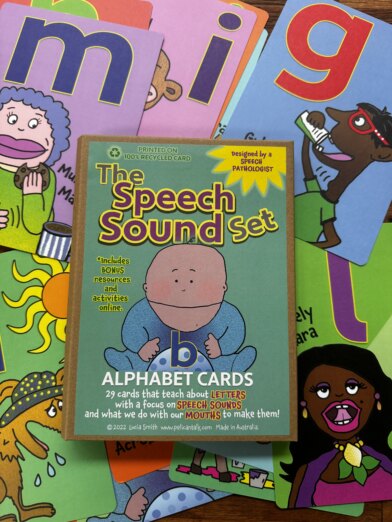
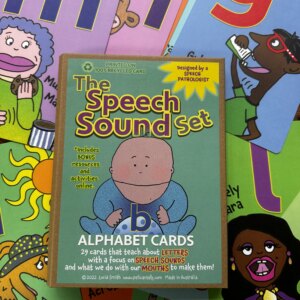
The Speech Sound Set Alphabet Cards - plus bonus online sound resources
Free Shipping This beautiful set of cards is the perfect way to introduce young learners to the alphabet using 29 fun characters that focus on the sounds each letter makes.The Speech Sound Set is well known to speech pathologists as the characters (the sound buddies) have mouthshapes that reflect the mouthshape required to make the sound of each letter.It's a FUN way of making the link between letters and sounds. These cards are A5 size and printed on 100 % recycled card. The colours are simply stunning. On the back of each card is a quick "SOUND STORY" to encourage exploration of the sound in focus, and some quick teaching tips.BUT WAIT! Along with the cards, you receive a link to online resources for EVERY SOUND in the pack. You receive flashcards to print (start sound pictures), sorting activities, letter recognition tasks, developmental norms, what to do if a child CAN'T say the sound - along with lots of teaching tips.

The Singing Alphabet (Ants on the Apple) Package
Get young learners ready for reading and writing using these fun pictures, handwriting sheets and songs.This ever-popular resource is used in many preschools, homes and schools across Australia.It's the perfect resource for introducing young children to letters and sounds and how they relate to words.Created by speech pathologists, the Singing Alphabet has a strong focus on sounds.Originally by Love and Reilly, this resource has been updated and re-illustrated. No more Itchy Indian! We now have Itchy Insect!And just because we want more of an Australian feel, Kicking King has also been kicked out. We now have Kicking Kangaroo!This is the downloadable version. Upon payment, the files will be available to you.

Start Sound Pictures
Say Them! Sort Them! Find the Odd-One-Out! This is a must-have resource for all teachers of early literacy - and it's perfect for articulation and phonology sessions too! It's colourful - and each word is carefully selected so children relate to them.Included in the resource are 12 Tips for Teaching First Sound Awareness.Each page targets one letter of the alphabet. The sound-link studied for each letter is the sound most commonly used in early phonics teaching.Twelve pictures for each letter/sound are provided in three columns. Each column also contains an “odd-one out”. This is useful in some of the activities described in the Teaching Tips.Pages targeting the digraphs SH, TH (the soft /th/ sound) and CH are also included.At the end of the document, a single page is dedicated to the vowels A, E, I, O and U (linked to the short vowel sounds). Two pictures are provided for each sound.The letter Q is a little different in that it is always accompanied by the letter U in English words. For this reason, QU appears at the top of this page. Note that QU actually makes two sounds (/k/ /w/). There are a limited number of picturable words beginning with QU so only three are provided. On the same page as QU, you will also see the pictures for the letter X. Also note that in early phonics teaching, students learn that X makes the sounds /k/ /s/. This does not occur at the start of words. For this reason, words with X at the end have been included.
Ready to meet Word Bird?
Give children a playful start with the sounds inside words, in eight minutes at mat time.
Get Word Bird