









Teaching Notes
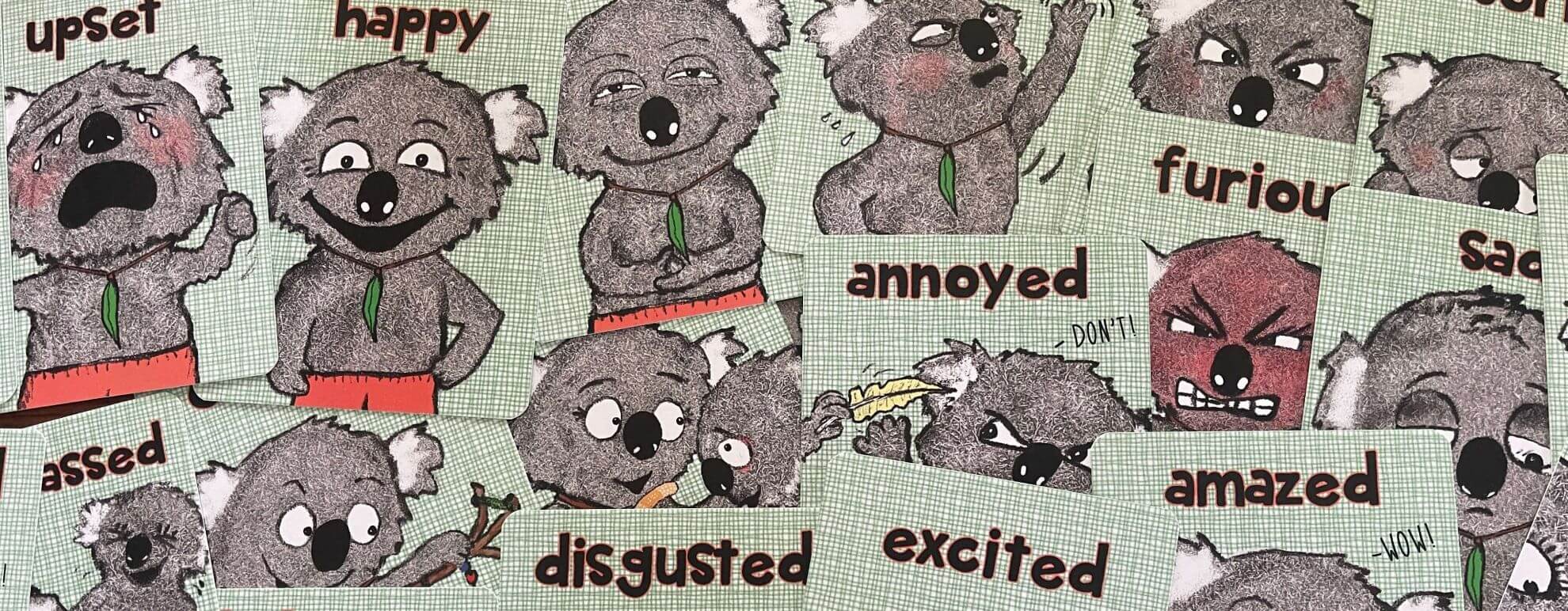
Below you will find BONUS ACTIVITIES that come with your purchase of The Coco Koala Emotions Cards.
Buy The Coco Koala Emotions CardsThis content is only available to customers of the Coco Koala Emotions Cards.
Feeling frustrated is a common emotion that everyone experiences when we are trying to – but can’t – change or achieve something.
Research has shown that low frustration tolerance in children is often linked to increased anger and emotional distress. For instance, children with lower frustration tolerance may react to setbacks with anger, tantrums, or avoidance behaviors. In contrast, those with higher tolerance are more likely to persist through difficulties and find constructive solutions. (Szasz, P.L., et al, 2010). Research even showed that children’s ability to tolerate frustration was linked to academic success two years after the study took place. (Meindl P. et al, 2019).
How to Explain Feeling Frustrated to Children
“Sometimes, you might feel frustrated. It’s an angry sort of feeling you get when you’re trying really hard to do something, but it’s just not working out. It’s like when you’re building a tower, and it keeps falling down, or when you’re trying to log in to a device and you can’t get your log in right.
When you’re frustrated, your body might feel tight. You might frown, clench your fists, or even feel like shouting or crying. Your heart might beat faster, and you might feel hot. You might say things like ‘I CAN’T DO THIS!’
It’s okay to feel frustrated. Everyone does sometimes. What’s important is learning how to handle it. Think of a different way to do something, take a break, get some help, and then keep trying.”
If you notice someone else looking frustrated, you can help by staying calm and saying something like:
- “Do you want some help?”
- “That ______ is pretty hard, isn’t it?”
Managing the Feeling
Like any feeling, it’s helpful to talk about it. You can say, “I feel so frustrated because…”
Here are some things you can do when you feel frustrated:
- Take deep breaths to calm your body.
- Take a short break and do something you enjoy.
- Talk to someone you trust about how you’re feeling.
- Try to find a different way to approach the problem.
- Get help if you need to!
Remember, frustration is a sign that you’re trying to do something important to you. With patience and practice, you can overcome challenges.()
Language to Explore
- Hitting a wall
- At your wit’s end
Time to Imagine
Here, Coco is feeling frustrated. What do you think might have made Coco feel this way?
Relate it to the Child
Can you think of a time when you felt frustrated?
- What happened?
- What did you do to feel better?
This Week
If someone you know is feeling frustrated, try saying, “Do you want to talk about it?” or “Can I help you with that?” Think about ways you can support them.
Additional Resources
- How Children Express Frustration – Scholastic
- Children’s self-regulation and coping strategies in a frustrated context in early education
- Building Emotional Resilience in Children
References
Szasz, P.L., Szentagotai, A., & Hofmann S.G., (2010). The effect of emotion regulation strategies on anger. Behaviour Research and Therapy, 48(12), 1146-1153, https://doi.org/10.1016/j.brat.2010.07.001
Meindl P, Yu A, Galla BM, Quirk A, Haeck C, Goyer JP, Lejuez CW, D’Mello SK, Duckworth AL. A brief behavioral measure of frustration tolerance predicts academic achievement immediately and two years later. Emotion. 2019 Sep;19(6):1081-1092. doi: 10.1037/emo0000492. Epub 2018 Nov 26. PMID: 30475031.